How to Calculate If It Is Too Late for a Fall Vegetable Crop
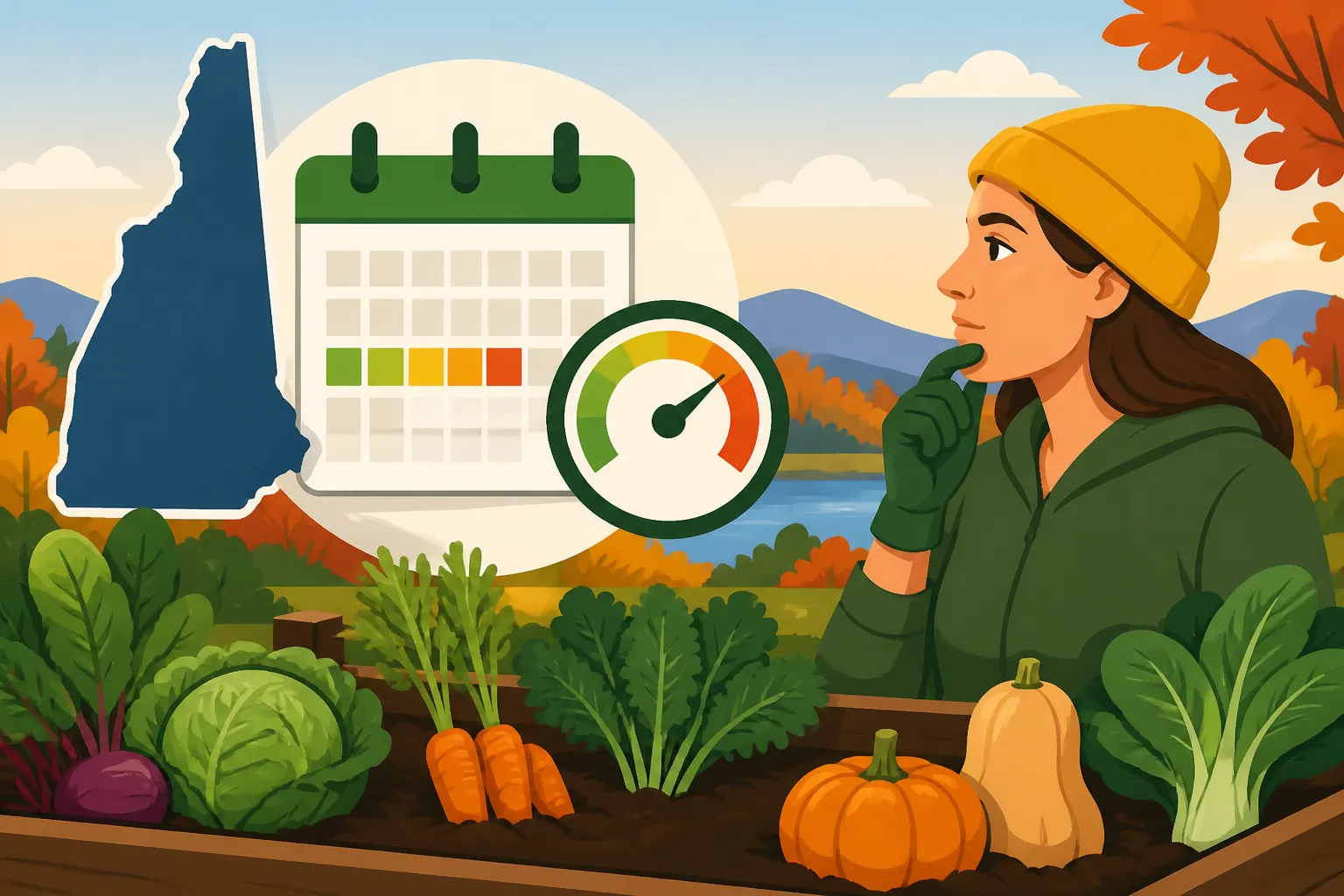
A fall crop can look promising on the seed packet and still run out of growing time before harvest. In New Hampshire, the key is to work backward from a local first-freeze estimate, then account for the crop’s days to maturity, slower fall growth, and the kind of cold it can tolerate. This calculation helps you decide whether to sow, transplant, choose a faster crop, or skip it.
Gather the information that determines your window
A useful planting calculation needs more than a calendar date. You need an estimate of when cold weather may affect your garden, the crop’s maturity information, and a realistic sense of how much risk you are willing to accept.
Start with a local first-freeze estimate
First-frost and first-freeze dates are probabilities, not fixed appointments. A date based on historical weather records describes the odds of a temperature event over a particular period; it does not predict what will happen in your garden this year. A nearby station is a starting point, not a guarantee for your exact yard.
Look for a local station or freeze table that reports the probability associated with its date. A date with a higher chance of a freeze is generally a more cautious planning point than one with a lower chance. For help matching your garden to a useful data source, see Finding Your Nearest NOAA Frost Station in New Hampshire and First Fall Freeze Dates Across New Hampshire Towns.
Choose the weather event that matters to your crop. Tender crops may be damaged by a light frost, while some cold-hardy vegetables can withstand light frost and may remain harvestable after it. A hard freeze can end the harvest for crops that tolerate only mild cold. If you plan around the first freeze but your crop is frost-sensitive, your schedule may be too optimistic. If you grow a cold-tolerant crop, the first frost may not be the end of its useful harvest period.
Your garden’s location matters, too. Cold air can settle in low spots, while slopes, nearby buildings, and exposure can affect how quickly a bed cools. A weather station’s reading will not capture every difference in your yard. Backyard Microclimates: Why Nearby Weather Stations Differ explains why gardens close to one another can experience different conditions.
Read the maturity information carefully
Seed packets and plant labels often give a days-to-maturity estimate, but the starting point can vary. For direct-sown vegetables, the estimate may be counted from sowing. For transplants, it may be counted from transplanting. Check the wording before doing the arithmetic; otherwise, you may accidentally count the plant’s indoor growing time twice or leave it out entirely.
Also clarify what “mature” means for the crop. It might mean a root has reached a usable size, a head has formed, or a fruit is ready to harvest. That may not be the same as reaching the size, flavor, or yield you prefer. Some crops can be picked young, which may make a late planting worthwhile even if it cannot reach full size.
Use the information for the particular crop and planting method you intend to use. A crop grown from seed outdoors does not necessarily follow the same schedule as a started plant set into the bed. For additional help interpreting those figures, see Counting Days to Maturity Before First Frost for Fall Vegetables.
Decide what level of risk is acceptable
There is no single calculation that makes a late planting certain to succeed. You are weighing the chance of a useful harvest against the cost of the seed, space, effort, and time. If the crop is important to your plans, use a more cautious freeze estimate and a larger buffer. If you are willing to accept a chance of losing the planting, you may choose a less conservative date.
It can help to sort possible outcomes into three groups:
| Result | What the calculation suggests | Practical choice |
|---|---|---|
| Comfortable window | The crop’s estimated maturity time plus a buffer fits before your chosen cold-weather cutoff | Sow or transplant, while monitoring weather |
| Tight window | The crop may mature, but the schedule leaves little room for slow growth or an early freeze | Choose a quicker harvest stage, protect the crop, or accept the risk |
| Unlikely window | The crop’s estimated time exceeds the available growing period | Choose a faster crop, use a transplant if suitable, or plan for another season |
This is a planning tool, not a promise about the weather. A comfortable window can still end with an early freeze, and a tight window can sometimes produce a harvest when autumn stays mild.
Work backward from the likely cold-weather cutoff
The basic calculation is simple:
Available days = days from your planting date to your selected freeze date
Then compare that number with:
Crop time needed = days to maturity + a weather and timing buffer
If the available days are comfortably greater than the crop time needed, the planting has a reasonable window. If the numbers are close, treat it as a gamble. If the crop needs more time than you have, it is probably too late for a full harvest under ordinary outdoor conditions.
Calculate the available days
Choose the freeze date or cold-weather cutoff that fits the crop. Then count calendar days from your proposed sowing or transplanting date to that cutoff. Use the same starting point the maturity estimate uses.
For example, if a packet describes maturity from sowing, count from the day you sow outdoors. If a transplant label gives time from setting the plant outside, count from transplanting. If you start seeds indoors and the packet’s estimate begins at sowing, the indoor period may already be part of the stated maturity time. Read the directions rather than assuming.
A calendar or date calculator can help avoid counting errors. Make a note of whether you include the planting day; the main goal is to use the same method when comparing the crop’s expected maturity with the available window.
Add a buffer for fall conditions
The maturity figure is an estimate under the growing conditions assumed by the seed company. Fall days are shortening, and temperatures are declining. Those changes can slow plant growth, especially for crops that need warmth and long days. A planting that just matches the packet’s estimate may not have enough time to produce a satisfactory harvest.
Build in a buffer rather than planning to reach maturity on the expected freeze date. A practical starting point is to allow roughly one to two extra weeks, then make the buffer larger when the crop grows slowly in cool conditions, the garden is exposed, or the weather estimate is less conservative. This is a planning allowance, not a guarantee or a universal rule. A mild autumn can make a smaller buffer work; an early cold spell can make even a larger one insufficient.
If your area is prone to early freezes, you might use a more cautious local probability, add extra time, or do both. For a broader approach to using local freeze information, see Planning Fall Harvests Around Local Average First Freeze Dates and Planning Fall Vegetable Beds: Working Around Autumn Frost Dates.
Interpret the result as a range, not a yes-or-no verdict
Suppose your calculation leaves a few days between estimated maturity and the expected freeze. That is not the same as having a safe schedule. Small differences in soil warmth, moisture, seedling establishment, or weather can use up the remaining time. A planting with a clear margin is less fragile.
Use this simple interpretation:
- If the available days exceed the crop’s maturity estimate by a comfortable margin, the planting is a reasonable candidate.
- If the available days only just cover the estimate, treat the planting as uncertain and consider a quicker harvest stage or protection.
- If the available days fall short, do not count on a full-size harvest. A faster crop or a different use of the bed may be more sensible.
For a more cautious estimate, compare more than one local freeze probability or station. The result will not eliminate uncertainty, but it can show whether your plan depends on an unusually long, mild fall.
Keep frost tolerance separate from maturity
A crop’s ability to survive cold does not tell you how quickly it will mature. Cold-hardy crops may tolerate light frost, but they still need enough time to establish and grow. Conversely, a fast-growing crop may reach harvest size quickly but be damaged by frost before you can pick it.
Use two checks:
- Can it reach a useful harvest stage in the available time?
- Can it tolerate the cold conditions likely before you finish harvesting?
Both answers matter. Which Cold-Hardy Vegetables Can Brave Early Spring Light Frosts? discusses cold tolerance; for fall planning, apply the same distinction between surviving a light frost and having enough growing time to produce a harvest.
Adjust the calculation for the crop and planting method
Two vegetables with similar maturity estimates may not behave alike in a fall bed. Their usable harvest stage, response to cold, and establishment needs can change whether a late planting is worthwhile.
Direct-sown crops and transplants use different clocks
Direct-sown crops begin outdoors as seed. They must germinate and establish before making much progress, and cool or dry soil can delay that start. The days-to-maturity figure may account for ordinary germination and growth conditions, but it cannot account for every garden’s soil and weather.
A transplant begins with some growth already completed, which can give it a head start. But a transplant needs time to settle into the garden after planting. If it is stressed, root-bound, or exposed to a sharp change in conditions, it may pause before growing actively. A transplant is not automatically a shortcut; its advantage depends on its condition, the crop, and whether the maturity estimate starts at transplanting.
For crops that can be direct-sown or transplanted, compare the instructions and count from the correct starting date. Direct-Sowing vs Starting Indoors for New Hampshire Gardens offers a wider comparison of those approaches.
Choose the harvest stage you actually want
A crop’s full-size maturity date may be later than the point when it is usable. Some leafy crops can be harvested as baby leaves; some roots can be picked young; and some vegetables are still worth growing for a smaller harvest. Decide whether that earlier stage fits your cooking plans before ruling the crop out.
Do not assume every crop improves when harvested young. A small root, immature head, or underdeveloped fruit may not be a useful substitute for the crop you wanted. Check the crop’s growing instructions and consider the quality you expect, not just whether the plant can produce something edible.
If your schedule is tight, an earlier harvest stage can be a sensible compromise. It should be part of the plan from the beginning, rather than an after-the-fact hope that the crop will be ready in time.
Think about the crop’s response to shortening days
Temperature is not the only seasonal change. Day length is decreasing as fall approaches. Some plants respond to shorter days or summer heat in ways that affect flowering, leaf growth, or harvest quality. Others continue growing well as conditions cool. A maturity estimate alone may not show how your crop will respond to the specific timing of a late sowing.
Consider the crop’s seasonal preference. Cool-season vegetables often suit fall planting better than heat-loving crops, but they still need enough time before the weather becomes too cold. Warm-season vegetables may need warm soil and a long enough stretch of favorable weather, making them especially risky late in the season. When the window is short, select a crop known to suit cool weather and a quick harvest rather than trying to force a heat-loving crop through declining conditions.
Account for your bed’s actual conditions
The number of days on a calendar does not equal the number of equally productive growing days. A shaded bed, compacted soil, poor drainage, or low soil fertility may slow growth. A warm, sunny, well-prepared bed may give a planting a better chance, but it cannot remove the risk of an early freeze.
Check the bed before sowing. Soil that is dry may need attention; soil that stays saturated can restrict roots and delay growth. Avoid making a late planting more ambitious by crowding it into a site where seedlings already struggle. If you are unsure whether the bed is dry below the surface, How to Check Soil Moisture at the Root Zone Before Watering explains a practical way to assess moisture.
Also consider how much space the crop needs and whether the bed is occupied. A crop that will not be harvested until after another planting is removed may have fewer available days than your first calculation suggests. Count from the actual date the bed will be ready, not the date you wish it were free.
Make a decision when the planting window is tight
A close calculation does not always mean you must give up. It does mean you should choose a plan that reflects the uncertainty, rather than treating a late planting as if it had a full season ahead.
Compare the options
| Situation | Option to consider | Trade-off |
|---|---|---|
| The crop is close to maturity but needs a little more time | Harvest at a smaller stage if the crop suits it | Smaller yield or size |
| A suitable transplant is available | Use a healthy transplant and count from the correct starting point | Transplant stress can slow establishment |
| The crop is slow-growing or frost-sensitive | Replace it with a quicker, more cold-tolerant choice | Different crop and harvest |
| The garden has a short remaining window | Use the bed for a later planting with a shorter maturity period | Less variety in the fall harvest |
| The crop is valuable to you and risk is acceptable | Plant a small area and protect it when appropriate | Protection takes effort and does not remove all risk |
A small trial planting can limit the cost of a gamble. It also leaves room for a crop with a better chance of maturing. If the planting succeeds, you can use the result to refine your timing next season.
Use protection as extra help, not extra days on paper
Row covers, low tunnels, or other suitable covers may reduce exposure to cold, depending on the materials, installation, and weather. They can help protect plants during a brief cold event, but they do not make a slow crop mature instantly or guarantee protection from a hard freeze. They also require monitoring and may need ventilation when conditions are warm.
If you plan to use a cover, include it as a risk-management step, not as a reason to ignore the maturity calculation. The crop still needs enough time and suitable growing conditions. Using Floating Row Covers to Start Vegetable Seeds Earlier and Covering Seedlings with Buckets and Blankets on Cold Nights explain some practical protection considerations.
Decide whether “too late” means no harvest or no full harvest
The answer depends on your goal. If you want a full-size crop for storage, you may need a longer window than if you are happy with a small, fresh harvest. If the crop can be picked in stages, you may get a worthwhile return before the weather ends production. If you need a dependable harvest, a tight schedule may not be worth the space.
A simple decision rule is:
- Plant it if the maturity estimate plus buffer fits the available window and the crop suits the likely cold.
- Plant a smaller amount or choose an early harvest stage if the schedule is tight but you want to try.
- Choose another crop if the crop needs substantially more time than remains or is unlikely to tolerate the expected cold.
For a bed that can support repeated plantings, a faster crop may be the better use of the remaining season. Midsummer Succession Sowing Windows for New Hampshire Gardens and Working Backward from Autumn Frost for Successive Harvests can help with planning more than one harvest.
Recalculate if the weather or planting date changes
The calculation is not a one-time decision. If you cannot sow when planned, update the planting date and count again. If a local forecast signals an unusually early cold spell, revise the risk assessment. A forecast can help with near-term decisions, but it does not replace historical probability information for the rest of the season.
Keep the assumptions with your notes: the crop, planting method, maturity estimate, chosen freeze cutoff, buffer, and actual harvest date. That record gives you a more useful starting point next year than relying on memory. It can also show whether the limiting factor was the crop’s maturity time, a cold pocket in the garden, late germination, or an early freeze.
Frequently Asked Questions
Should I use the first frost date or the first freeze date?
Use the event that matters to the crop. A frost-sensitive vegetable may be damaged by light frost, while a cold-tolerant crop may continue after one. For a crop that cannot take a hard freeze, plan around a freeze estimate rather than assuming the first light frost ends the season. Both dates are probabilities, not fixed predictions.
Do days to maturity include time spent indoors?
It depends on the label or seed packet. Check whether the estimate begins at sowing, transplanting, or another stage. Count from that same point. If the directions are unclear, contact the seed provider rather than guessing, because starting the clock incorrectly can make the schedule misleading.
Can I plant a crop after its calculated window has passed?
You can plant it, but do not count on the full harvest described by the maturity estimate. A smaller harvest may still be possible for crops that can be picked young. Otherwise, a quicker or more cold-tolerant crop may be a better use of the remaining space.
Will a row cover make a late crop safe?
A cover can reduce cold exposure in some conditions, but it cannot guarantee protection or compensate for too little time to mature. Treat it as one part of a plan that still includes a suitable crop, a realistic maturity estimate, and a local freeze-risk assessment.
Disclaimer
This article is for general informational purposes only and does not constitute professional advice. Laws, prices and regulations vary by location and change over time. Consult a qualified professional for guidance on your specific situation. New Hampshire Gardening Guide is not a government agency and is not affiliated with any university extension, state department of agriculture or other government agency.