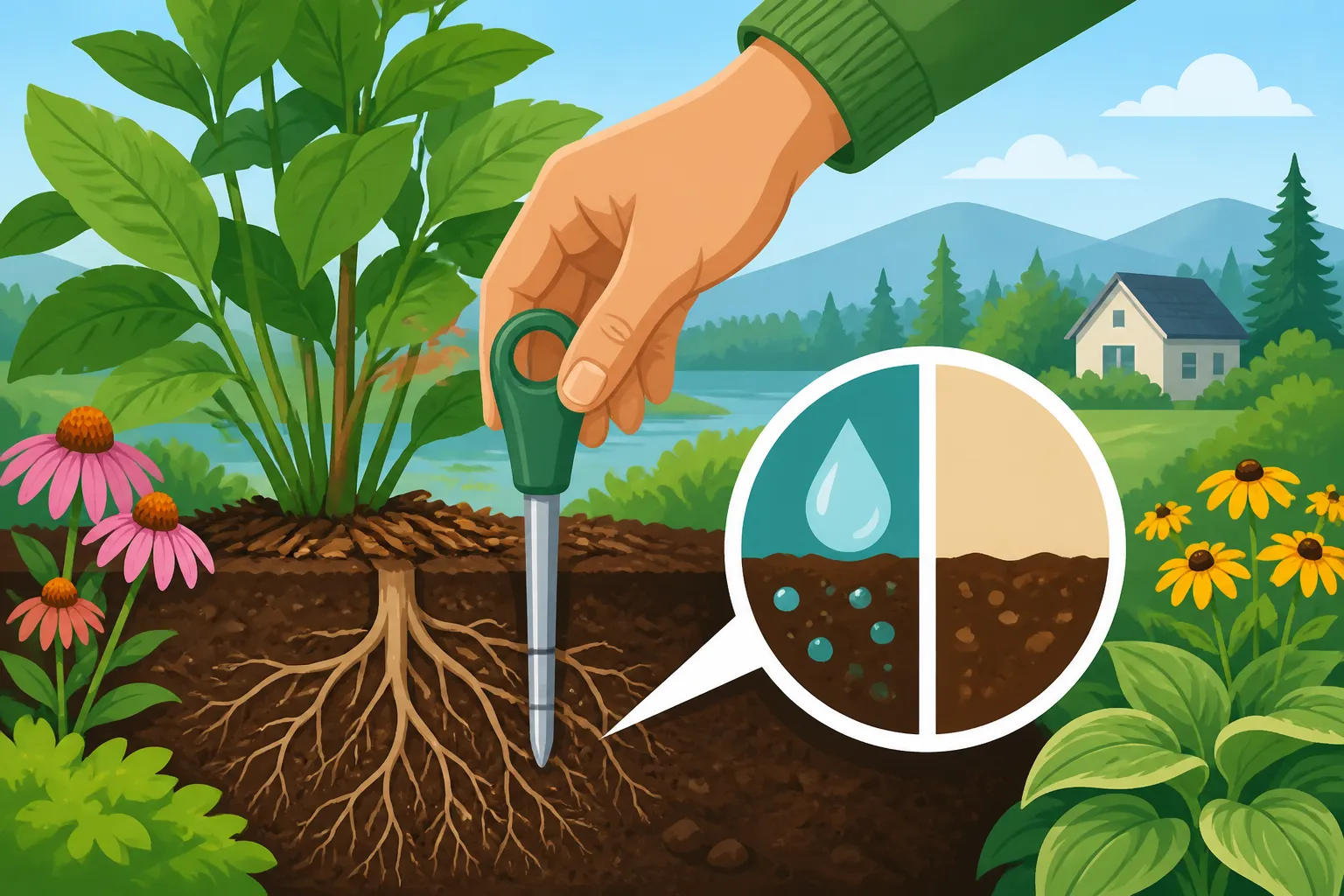
How to Check Soil Moisture at the Root Zone Before Watering
A dry-looking surface does not always mean your plants need water, and a recent shower does not guarantee that moisture reached their roots. Checking the root zone before watering helps avoid both needless watering and drought stress. Here are practical ways to inspect garden beds and containers, interpret what you find, and adjust your next step to New Hampshire soil and weather.
What a root-zone moisture check tells you
The root zone is the soil area where a plant’s active roots take up water. Its depth and spread vary with the plant, its age, and growing conditions. A newly planted seedling may rely on a small, shallow area, while an established plant can draw from a wider and deeper volume of soil. That is why a quick look at the surface can be misleading.
The purpose of a moisture check is not to find one perfect reading for every plant. It is to answer a more useful question: Is the soil around the active roots moist enough, or has it dried enough that watering is appropriate? The answer can differ between two beds only a short distance apart.
For example, a raised bed may dry faster than the ground around it. Sandy soil drains and dries sooner than soil with more fine particles. A thick mulch layer can leave the surface looking dry while the soil beneath remains moist. A brief shower may wet the top few inches without replenishing water deeper in the bed.
In New Hampshire, local conditions add another layer of variation. A sunny, exposed bed may lose moisture faster than a shaded one. Wind, slope, soil texture, and recent rainfall all affect how quickly a particular spot dries. A garden’s conditions can also change through the season as plants grow, roots spread, and temperatures shift.
A regular check helps you notice those differences before watering. It can also help explain symptoms that are easy to misread. Wilting, for instance, can result from dry soil, but plants may wilt temporarily during heat or have trouble taking up water in soil that stays too wet. Checking the soil helps distinguish those situations better than relying on leaves alone.
It is also useful to separate two decisions:
- Is the root zone dry enough to need water?
- If watering is needed, will the water reach the roots?
A moisture check answers the first question. Checking again after watering can help answer the second. For guidance on how water should reach roots in a vegetable bed, see How Deeply to Water Vegetable Beds to Reach Feeder Roots.
How to check soil by hand or with a tool
A direct inspection is often the simplest and most useful starting point. It lets you see and feel the soil where roots are growing rather than infer moisture from the weather or the surface.
Choose a representative spot and depth
Check near the plants, but avoid digging right against a stem or through a dense root mass. In a bed with different crops, check more than one area. A sunny edge and a shaded center may not have the same moisture level. If one part of a bed is on a slope or has a different soil texture, check that area separately.
The depth matters as much as the location. Scraping the surface or pressing a finger into the top layer only tells you about that layer. To assess a deeper root zone, use a finger where possible, or take a small sample with a hand trowel or narrow garden tool. The goal is to inspect the soil at the depth where the plant’s active roots are likely to be, without cutting through roots unnecessarily.
If you are unsure how deep to check, compare the soil near the surface with a sample from farther down. That comparison may reveal a dry crust above moist soil, or a damp top layer above a dry lower layer. Both patterns are common after light rain or shallow watering.
Read the soil’s feel and appearance
Soil texture affects how moisture feels. A sandy soil can feel damp without forming a firm ball. Soil with more silt or clay may hold together more readily when moist. Rather than depend on a single test, consider the combination of feel, appearance, and how easily the soil crumbles.
| What you find in the root zone | What it can suggest | A sensible next step |
|---|---|---|
| Soil feels cool and moist and holds together loosely | There may be adequate moisture at that depth | Wait, then check again as conditions change |
| Soil feels dry, dusty, or crumbly through the active root area | Water may be needed | Water the root zone and check that moisture penetrates |
| Topsoil is dry but soil below is moist | Moisture remains deeper down | Avoid watering just to wet the surface |
| Soil is wet, sticky, or saturated | Drainage may be slow or watering may have been excessive | Pause watering and check whether the area drains |
| One section is moist while another is dry | Conditions vary across the bed | Water the dry area rather than treating the whole bed alike |
These are clues, not universal thresholds. Soil composition affects what “damp” feels like, and different plants have different water needs. A comparison with the soil in the same bed after a thorough watering can help you learn how that soil feels when moist.
Use a trowel or probe when fingers are not enough
A narrow trowel is useful when the soil is too compact, the root zone is deeper than a finger can reach, or you want to compare two depths. Remove a small amount of soil, inspect it, and return it to the opening afterward. Take care around stems, buried irrigation lines, and established roots.
A soil probe can make it easier to sample below the surface, though it may be hard to push into rocky or very dry soil. If the probe comes out with a sample, feel that soil rather than judging moisture only from how easily the tool entered. Resistance can reflect stones, compaction, or soil structure as well as dryness.
For beds that dry quickly, checking below the surface is especially valuable. Watering Sandy Soil: Understanding Garden Soil Pore Space and Sand explains why sandy soil may lose moisture faster and why a surface-only check can give the wrong impression. For other approaches to deeper bed checks, see Testing Garden Soil Moisture Deep in the Bed Before You Water.
Treat meters as one clue, not a verdict
A moisture meter can be convenient if you check several beds or prefer not to dig. Its reading is most useful when you use the same meter consistently, at the same depth, and compare results with what you feel in the soil.
Do not assume a meter gives an exact moisture percentage that applies to every soil or plant. Readings can be affected by soil texture, stones, contact between the sensor and soil, and the condition or design of the meter. A meter may also report a different result if it is placed near a dry surface layer one time and deeper in the root zone the next.
If a reading seems surprising, verify it with a small soil sample. Over time, comparing meter readings with the feel of your soil can help you understand what its scale means in your garden. A meter is an aid to observation, not a replacement for it.
Adjust the check for beds, containers, and different soils
The basic method stays the same—inspect the soil where roots are active—but the best place and way to check can vary by garden setup.
Vegetable beds and mixed plantings
In a vegetable bed, plants may have very different root systems and growth stages. A recently sown row, a small transplant, and a mature fruiting plant do not necessarily use water at the same depth or rate. Check an area that represents the crop you are deciding about, rather than assuming the entire bed has one moisture level.
For rows of seedlings, avoid repeatedly digging into the seed line. Check beside it, or use a careful finger check where it will not disturb emerging plants. For established vegetables, use a trowel to examine soil farther down when the surface is dry but the plants look healthy. A single shallow check can lead to unnecessary watering if the lower soil is still moist.
Raised beds also need their own checks. Their exposed sides and looser fill can make them dry differently from surrounding ground. The material used to fill the bed and how the bed drains both matter. Do not assume a raised bed needs water merely because a neighboring in-ground bed looks dry, or that the two need the same amount at the same time.
If you are planning moisture management for a raised bed, Raised Bed Vegetables for New Hampshire Gardens can help with the broader growing setup. For plant-specific watering depth, use what you find in the soil alongside the information in How Deeply to Water Vegetable Beds to Reach Feeder Roots.
In-ground beds with varied soil
A garden may contain more than one soil texture. An area amended with compost can retain moisture differently from a nearby patch of native soil. A low spot may stay damp after a slope has dried. Check locations that differ in sun, drainage, or soil, especially if plants in those areas behave differently.
Sandy soil often drains rapidly, so inspect below the surface rather than relying on a dry crust. Heavier soil can remain wet longer, even when the top looks dry. If you repeatedly find wet soil at root depth, watering more may worsen the problem. Consider whether water is draining away or pooling, and whether the bed’s structure needs attention. How to Irrigate Fast-Draining Garden Soil Without Runoff offers additional help when water moves through a bed too quickly.
Mulch can complicate a quick visual check. It reduces direct evaporation from the soil surface, which is useful, but it can also conceal what is happening underneath. Move the mulch aside before checking. Feel the soil itself, then replace the mulch so it continues to cover the bed.
Containers and patio planters
Containers have less soil volume than garden beds and may dry more quickly, particularly in sun or wind. Their outer edges can dry before the center, so check near the root ball rather than judging from the pot’s surface alone. For a small container, a finger check may be sufficient; for a larger planter, use a narrow tool or a suitable moisture meter to check farther down.
Drainage holes matter. Soil that stays saturated can indicate that water is not draining properly, or that the container is being watered before the root zone has dried enough. A container’s weight can provide a rough comparison after you have felt the soil: a dry pot is often lighter than the same pot when its mix is moist. Weight is a supporting clue, not a substitute for checking the mix.
Different potting mixes also behave differently from garden soil. Some can feel dry at the surface while retaining water inside; others may dry rapidly in warm, exposed spots. Check the mix and the plant rather than following a fixed watering interval. For further container-specific guidance, see How Often to Water Potted Herbs as Soil Dries in Summer Heat and Watering Container Flowers vs Established Perennials in Granite Soils.
New plantings and shallow roots
New transplants and seedlings are not yet rooted through a large volume of soil. Their immediate root area can dry sooner than the surrounding bed, so check close enough to assess the soil they actually occupy. Be gentle: digging directly beside a small plant can damage its roots.
As plants establish, their roots extend into a wider area. A check that was useful just after planting may no longer represent the full root zone later in the season. Adjust the location and depth of your inspection as the plant grows. When moving seedlings outdoors, their first days in the garden can also require closer observation while they adjust; see Starting Seeds Indoors: Hardening Off Seedlings Step-by-Step for related transplant preparation.
Use weather and plant signals without relying on them alone
Recent rain is useful context, but it does not tell you exactly how much moisture reached the roots. A short shower may wet leaves and the soil surface while leaving deeper soil dry. A longer period of rain may still leave a raised bed or a fast-draining patch relatively dry. Check the root zone after rainfall rather than assuming that rain has either solved the problem or made watering unnecessary.
Other conditions help explain what you find:
- Sun and exposure: Beds in full sun or exposed to wind may dry sooner than sheltered beds.
- Soil texture: Coarser soil often drains faster, while fine-textured soil can retain water longer.
- Slope and drainage: Water may run off a sloping bed or collect in a low area.
- Mulch: A cover can slow evaporation, but the soil below it still needs inspection.
- Plant size and growth: Larger plants and active growth can change how quickly a bed uses moisture.
- Recent watering: Water may have reached only part of the root zone if it ran off or was applied too quickly.
Leaves can prompt a check, but they do not diagnose soil moisture by themselves. Wilting in hot weather may be temporary, while persistent wilting can have several causes. If the soil at root depth is already wet, adding more water may not help. Check the soil first, then look at drainage, plant condition, and recent weather before deciding what to do.
A useful routine is to check a few representative spots, especially those that tend to dry first or stay wet longest. You do not need to inspect every plant every time. Make a mental note of how the soil feels after rainfall, after watering, and during a dry spell. That gives you a local reference that is more reliable than a fixed calendar or a neighbor’s watering routine.
For additional context on checking beds before watering, see How to Check Soil Moisture at the Root Zone Before Watering is the current topic, so do not use it as an internal link. Instead, the practical companion How to Irrigate Fast-Draining Garden Soil Without Runoff can help when your check reveals rapid drying or runoff.
Decide whether to water, then verify the result
Once you have inspected the root zone, use what you found to choose the next step.
- If the active root area is still moist, wait. A dry surface alone is not a reason to water. Recheck when weather or plant conditions change.
- If the root area is dry, water the soil rather than just the foliage. Aim for a steady application that can soak in. If water begins to run off, pause and let it absorb before continuing.
- Check again after watering. Inspect at the depth you used before. If the soil is moist only near the surface, the water may not have reached the active roots.
- Adjust the next application based on what happened. A bed that remains wet for a long time needs a different approach from one that dries quickly. Make changes to the watering method or the area being watered rather than relying on a preset schedule.
The follow-up check is important because watering can appear successful while leaving roots dry. This is more likely when water is applied too quickly, the soil is compacted, or the bed sheds water at the surface. Slow application in stages can give water time to infiltrate. In very fast-draining beds, smaller areas may need attention separately; How to Irrigate Fast-Draining Garden Soil Without Runoff covers that challenge.
Conversely, wet soil is not always a sign of success. If the root zone remains saturated, wait before watering again and observe whether the soil drains. Persistent wetness can be a sign that the location or soil structure is poorly drained. Plants in such conditions may show stress even though water is abundant, because roots also need air in the soil.
Keep your approach flexible. A recent rain, a cloudy stretch, or cooler weather can change how quickly beds dry. A warm, windy period can do the opposite. The best interval between checks is therefore the one that fits the conditions you see, not a universal number of days.
Frequently Asked Questions
Should I water when the soil surface looks dry?
Not automatically. Move mulch aside and check the soil at root depth. The surface may dry while deeper soil remains moist, or a shower may wet the surface without reaching the roots.
Is a moisture meter more accurate than checking by hand?
Not necessarily. A meter can help compare spots and depths, but its readings can be affected by soil texture and sensor contact. Use it consistently and verify unexpected readings with a soil sample.
How many places in a bed should I check?
Check enough locations to account for meaningful differences, such as sun, slope, soil texture, or drainage. A sunny bed edge and a shaded low area may need separate checks.
Should I water if a plant is wilting?
Check the root-zone soil first. Dry soil may call for watering, but wet soil and wilting together suggest that simply adding water may not solve the problem.
Disclaimer
This article is for general informational purposes only and does not constitute professional advice. Laws, prices and regulations vary by location and change over time. Consult a qualified professional for guidance on your specific situation. New Hampshire Gardening Guide is not a government agency and is not affiliated with any university extension, state department of agriculture or other government agency.